- Home
- How to build a shed
- Nail Gun vs. Hammer and Nails
Nail Gun vs Hammer and Nails: What Diy Shed Builders Need to Know
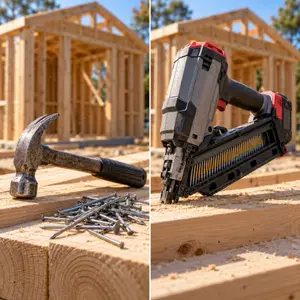
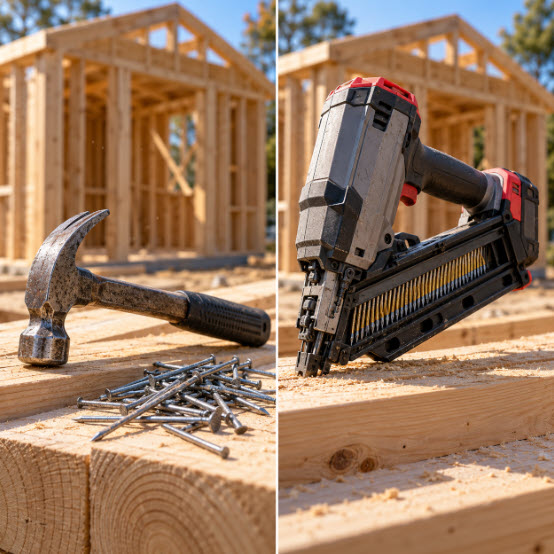 What's Best For Building Your Shed - Hammer and Nails or Nail Gun?
Your shed project is staring you down, and you need to decide: power through with a nail gun or stick with the hammer you already own.
The choice between these two tools isn't just about speed. It's about accuracy, fatigue, upfront cost, and whether you'll actually finish before the weather turns. A nail gun can drive 60 nails per minute while your arm is still warming up with a hammer. But that speed comes with a price tag, a learning curve, and maintenance requirements that a $20 hammer will never demand.
Both tools will get your shed built. The question is which one matches your skill level, budget, and tolerance for sore wrists.
How should you choose?
Here's what actually matters when you're choosing between raw power and old-school reliability.
What You're Actually Comparing
This isn't a tool beauty contest. It's a decision that will impact every hour you spend on your shed build.
A nail gun is a pneumatic, electric, or battery-powered tool that drives nails in a fraction of a second with consistent depth and minimal effort. A hammer and nails represent the traditional manual method where you control every strike, every angle, and every ounce of force. One requires an investment in equipment and possibly an air compressor. The other requires nothing but your arm and a box of nails.
Nail guns dominate in speed and reduce physical strain, making them the go-to choice for professionals and DIYers tackling large projects. You can frame an entire wall in the time it takes to hand-drive a dozen nails. The downside is the initial cost, which ranges from $100 for a basic pneumatic framing nailer to over $400 for a high-end cordless model, plus the cost of an air compressor if you go pneumatic.
Hammers are inexpensive, require zero setup, and never run out of battery. They're also quieter, lighter to carry around, and easier to control in tight spaces where a bulky nail gun won't fit. The tradeoff is physical exhaustion, slower progress, and a higher chance of bent nails or missed strikes that damage your lumber.
If you're building a 12x16 shed with hundreds of framing connections, the tool you choose will either save you hours of back-breaking labor or cost you a few hundred dollars you weren't planning to spend. Neither choice is wrong, but one will fit your situation better than the other.
Speed and Efficiency
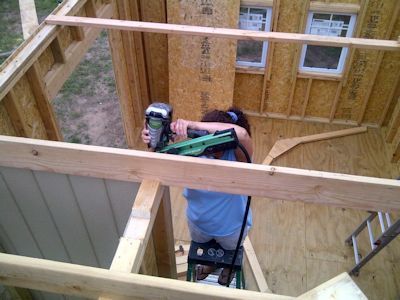 A Nail Gun Might Turn Out To Be Your Best Friend!
Time is the biggest differentiator, and it's not even close.
When you're framing walls, installing sheathing, or securing roof trusses, speed determines whether your project finishes in a weekend or drags into next month. A nail gun fires a nail in less than a second and seats it perfectly flush every time. A hammer requires 3 to 6 swings per nail, plus the time it takes to position the nail, steady your stance, and recover from the impact vibration in your arm.
- Nail gun: 60 nails per minute under optimal conditions, with zero fatigue until the battery dies or the compressor needs a break.
- Hammer: 10 to 15 nails per minute if you're experienced and your arm isn't tired yet. That number drops fast after the first hour.
Here's what that means in real terms. If your shed framing requires 500 nails, a nail gun will finish the job in under 10 minutes of actual nailing time. A hammer will take you 35 to 50 minutes of continuous swinging, and that's assuming you don't miss, bend nails, or need breaks for hand cramps. Add in fatigue, and the hammer timeline stretches even further.
But speed isn't the only factor. A nail gun also maintains consistent depth and angle, which matters when you're securing structural joints that need to meet code. Hand-driving nails leaves room for over-driven nails that split the wood or under-driven nails that compromise the connection. A nail gun eliminates that variability.
If you're building solo and need to finish before a storm rolls in, the nail gun will save your project. If you're working casually over a few weekends with no deadline pressure, the hammer keeps you moving without the upfront investment.
Cost breakdown

The hammer wins on price, no question. You're looking at a total investment under $50 versus $250 to $550 for a functional nail gun setup. That gap matters if this is a one-time shed build and you don't plan to use the nailer again.
But here's the flip side. If you're planning additional projects like a fence, a deck, or interior trim work, that nail gun becomes a tool you'll use repeatedly. The cost per project drops significantly when you spread it across multiple builds. A $400 cordless nailer that saves you 15 hours across three projects suddenly feels like a bargain compared to the physical toll of hand-driving thousands of nails.
Pneumatic nailers are cheaper upfront but lock you into the compressor ecosystem. Cordless nailers cost more initially but offer mobility and eliminate the hassle of dragging hoses around your build site. For a single shed, the hammer is the budget winner. For anyone planning to build more than once, the nail gun pays for itself in saved time and preserved energy.
Physical Demand and Fatigue
Your body will remind you which tool you chose by the end of day one.
Driving nails with a hammer is a full-body workout. Your shoulder stabilizes, your elbow hinges, your wrist snaps, and your core braces with every swing. After 100 nails, you'll feel it. After 300, you'll be questioning your life choices. Repetitive hammering leads to wrist strain, tennis elbow, and shoulder fatigue, especially if your form breaks down as exhaustion sets in.
A nail gun eliminates 95% of that physical strain. You position the nose, squeeze the trigger, and move to the next nail. There's no impact shock, no repeated swinging motion, and no cumulative damage to your joints. The only fatigue comes from holding the tool's weight, which ranges from 7 to 10 pounds for most framing nailers. That's manageable for anyone who can handle a power drill for extended periods.
But there's a safety tradeoff. Nail guns are responsible for 37,000 emergency room visits per year, most from accidental discharges, double-fires, or nails ricocheting off knots in the wood. A hammer might leave you sore, but it won't shoot a 3-inch nail through your hand if you lose focus for a second. Proper safety gear and trigger discipline are non-negotiable with a nail gun.
If you're under 40, in decent shape, and only building one shed, the hammer is physically doable. If you're over 50, dealing with joint issues, or planning a multi-day build, the nail gun will keep you functional and pain-free.
Accuracy and Control
One tool does what you tell it. The other does what it's programmed to do.
A hammer gives you complete control over every strike. You decide the angle, the force, and the depth. That matters when you're working around obstacles, adjusting for warped lumber, or making fine adjustments in tight spaces. You can feather a nail into place with light taps or drive it home with one decisive swing. That level of control is irreplaceable when precision matters more than speed.
A nail gun sacrifices some of that control for consistency. Depth adjustment lets you dial in how far the nail sinks, but you're locked into the tool's firing angle and the nail's trajectory. If the wood has a hidden knot or the grain shifts unexpectedly, the nail gun will still fire at full force, potentially splitting the board or deflecting the nail into an unintended path.
- Hammer advantage: You can stop mid-swing, reposition, and adjust based on real-time feedback from the wood.
- Nail gun advantage: Every nail seats at exactly the same depth with zero variation, which matters for structural integrity and professional-looking results.
For framing and sheathing where speed and uniformity matter most, the nail gun wins. For detail work, corner bracing, or any situation where you need to feel the wood and adjust on the fly, the hammer is the better tool. Many experienced builders use both: a nail gun for the bulk of the framing and a hammer for the finicky spots where precision trumps speed.
Nail Guns and Noise
Noise and Neighbor Considerations
If you live in a neighborhood with noise restrictions or close-quartered homes, this factor isn't optional.
A hammer is nearly silent. The loudest sound is the crack of wood fibers compressing as the nail sinks. You can build at 6 a.m. or 9 p.m. without waking anyone or violating local noise ordinances.
A pneumatic nail gun produces 90 to 100 decibels per shot, roughly the same volume as a chainsaw or a jackhammer. Fire 60 nails per minute, and you're creating a continuous percussion that will annoy every neighbor within 200 feet. Cordless nailers are slightly quieter at 80 to 90 decibels, but still loud enough to require ear protection and draw complaints.
Some HOAs and municipalities restrict power tool use to specific hours, typically 8 a.m. to 6 p.m. on weekdays. If your build schedule conflicts with those windows, the hammer becomes your only legal option. Even without formal restrictions, repeated nail gun fire on a Saturday morning is a fast way to make enemies.
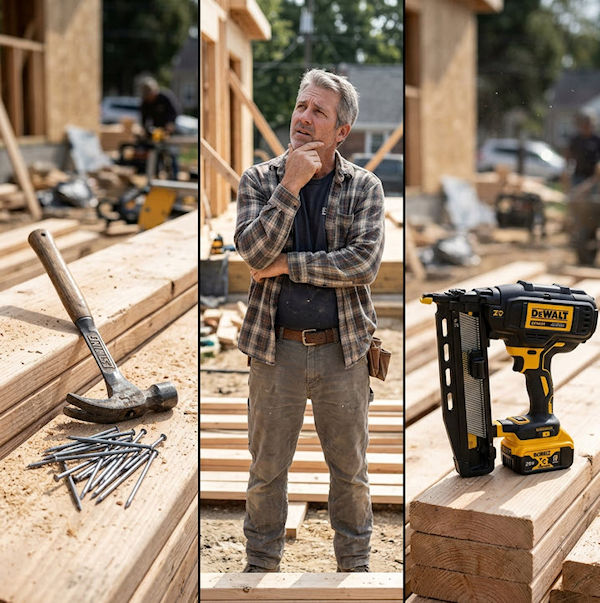 You Still Can't Decide About Whether Investing In a Nail Gun Is A Wise Decision?
Noise also impacts your own hearing. Extended exposure to 90+ decibel tools without ear protection causes permanent hearing damage. A hammer lets you work all day without earplugs. A nail gun requires them every single time.
If you value flexibility in your build schedule or want to stay on good terms with the people living around you, the hammer's silence is a legitimate advantage.
Learning Curve and Skill Requirements
One tool you already know how to use. The other requires reading the manual.
Everyone has swung a hammer. The learning curve is zero. You might not be fast or efficient on day one, but you'll figure out the rhythm within the first 20 nails. The only skill that improves with practice is consistency and speed, both of which develop naturally as you work through the project.
A nail gun requires actual training. You need to understand depth adjustment, jam clearing, sequential vs. bump firing, air pressure settings for pneumatic models, and battery management for cordless versions. First-time users often overdrive nails, fire blanks, or jam the magazine because they didn't load the nail strip correctly or set the pressure too high.
There's also a safety protocol you need to internalize. Never place your hand in front of the nose. Always disconnect the air or battery when clearing jams. Never bypass the safety tip. Keep your finger off the trigger until you're ready to fire. These aren't suggestions, they're requirements, because nail gun injuries are severe and happen fast.
If you're comfortable with power tools and willing to spend 20 minutes reading instructions and practicing on scrap wood, the nail gun's learning curve is manageable. If you want to start building immediately without any setup or training, the hammer is the no-brainer choice.
Portability and Workspace Requirements
Where you're building and how much space you have matters more than you think.
A hammer fits in your back pocket. You can carry it up a ladder, squeeze into tight corners, and work in spaces where there's no room to maneuver a bulky tool. You're never tethered to a power source, an air hose, or a charging station. If you need to move from one side of the shed to the other, you just walk. No cords, no hoses, no logistical planning.
A pneumatic nail gun chains you to an air compressor. That compressor weighs 30 to 60 pounds, requires a power outlet, and feeds a hose that snags on everything. You're constantly managing slack, dragging the hose around corners, and repositioning the compressor as you move from wall to wall. It's doable, but it adds friction to every task.
A cordless nail gun eliminates the hose problem but introduces battery management. Most framing nailers get 500 to 700 shots per charge, which sounds like a lot until you realize a shed frame can require 1,000+ nails. You'll need a backup battery and a charging plan, or you'll be sitting idle while the tool recharges at the worst possible moment.
If your build site has limited space, no easy access to power, or involves a lot of vertical work on ladders, the hammer's portability is a massive advantage. If you're working on flat ground with ample space and nearby electricity, the nail gun's mobility challenges are manageable.
Maintenance and Reliability
One tool works forever with zero upkeep. The other demands attention.
A hammer is indestructible. Drop it, leave it in the rain, use it as a pry bar, and it will still drive nails 20 years from now. There are no moving parts to break, no seals to replace, and no maintenance schedule. The only thing that wears out is the handle, and even that takes decades of abuse.
A nail gun is a mechanical system with failure points. Pneumatic nailers need O-ring replacements, driver blade lubrication, and periodic cleaning to prevent jams. Cordless nailers require battery replacements every 2 to 3 years at $80 to $150 per battery. Air compressors need oil changes, moisture drainage, and filter replacements. All of this costs time and money.
Nail guns also jam. Dust, bent nails, or incorrect loading can stop your workflow dead until you clear the magazine and reset the driver. Jams are more frequent in cheap nailers or when using off-brand nail strips. A hammer never jams, never misfires, and never needs troubleshooting.
If you want a tool that works every time you pick it up without thinking, the hammer wins. If you're willing to invest in basic maintenance and accept occasional downtime, the nail gun's reliability is fine but not bulletproof.
When the Hammer Actually Wins
Don't let the speed advantage fool you. There are real scenarios where the hammer is the smarter choice.
You should use a hammer if:
- This is your only shed build and you don't plan to use a nail gun again. The cost-per-use makes the investment hard to justify.
- Your budget is tight and you can't afford $250+ for a tool that will sit unused after this project.
- You're working in a noise-restricted area or building outside of typical power tool hours.
- You don't have access to electricity and don't want to manage batteries or haul a generator.
- You're comfortable with hand tools and prefer the simplicity of no cords, hoses, or maintenance.
- Your shed is small (under 8x8) and the total nail count is low enough that speed isn't a bottleneck.
The hammer also makes sense if you're risk-averse about power tool injuries or working alone without anyone nearby to help if something goes wrong. A hammer's worst-case scenario is a bruised thumb. A nail gun's worst-case scenario involves a trip to the emergency room.
If any of these apply, skip the nail gun. You'll save money, eliminate complexity, and still end up with a solid shed.
When the Nail Gun Is Worth Every Penny
Speed, endurance, and professional results. That's where the nail gun pays off.
You should use a nail gun if:
- Your shed is 10x12 or larger and requires 800+ nails for framing, sheathing, and roofing.
- You're building solo and need to maximize productivity during limited weekend hours.
- You have joint issues, limited upper body strength, or a history of repetitive strain injuries.
- You plan to build additional structures (fence, deck, pergola) and will reuse the tool multiple times.
- You're aiming for contractor-quality results with consistent nail depth and zero bent fasteners.
- You already own a compressor or are ready to invest in cordless tools for future projects.
The nail gun also wins if time matters more than cost. If you need the shed finished in a weekend because materials are getting delivered Monday or weather is closing in, the speed advantage is non-negotiable. A hammer might save you $300, but it will cost you days of labor and physical punishment.
If you check two or more boxes on this list, the nail gun is the right call. The investment will pay for itself in saved time and reduced wear on your body.
Nail Gun or Hammer and Nails? The Verdict
For a one-time 8x10 shed build by a DIYer with a tight budget and no time pressure, the hammer wins. You'll save $250+, avoid the learning curve, and finish the project without investing in tools you won't use again. Expect to spend 8 to 12 hours driving nails and plan for sore arms the next day.
For anyone building a 10x12 or larger shed, planning future projects, or prioritizing speed and comfort, the nail gun is worth every dollar. You'll cut build time in half, eliminate physical strain, and produce cleaner results. Go cordless if you value mobility. Go pneumatic if you already own a compressor or want to save $100 upfront.
Both tools will get your shed built. The hammer is the budget-friendly, no-nonsense option for casual builders. The nail gun is the investment that pays dividends in time saved and pain avoided. Choose based on your project size, budget, and how many more things you plan to build after this shed is standing.
You might like these
Using drip edge on your shed roof
Do you really need drip edge on your shed roof? As a professional shed builder, I can tell you that drip edge is a necessity.
Shed Floors - Band Boards, Rim Joists, Joists and Skids.
Shed floors and the different parts of a shed floor.
How to use a speed square for building your shed trusses and walls
How to use a speed square to easily make angle cuts for shed walls, floors, and trusses for building your shed.
Monthly DIY
Shed-in-sight
Newsletter
Subscribing will get you discounts on shed plans, monthly updates, new shed design ideas, tips, exclusive discounts on shed building resources and tools. Learn more here.
Recent Articles


-
Shed Walls, Shed Construction, Building a Shed
Oct 14, 26 05:57 AM
 How to frame and build shed walls. Detailed framing pictures and illustrations for use with your shed construction.
 -
Nail Gun vs Hammer: What Shed Builders Need to Know
Oct 14, 26 05:53 AM
 Should you use a nail gun or hammer and nails when building your shed? Here's a full breakdown of what you need to know with the key differences explained.
 -
Shed Plans For Building a 16x20 Barn Shed
Sep 28, 26 07:10 AM
 Our 16x20 barn shed plans come with a huge loft and stairway and is perfect for building your workshop, craft or hobby studio or backyard guest house.
My You Tube Videos